
Related News
- 00
0000-00
Selecting High-Speed Aluminum Foil Mills: Speed, Gauge and Tension Control - 00
0000-00
How Metallurgical Thermodynamics Research Predicts Steelmaking Reactions - 00
0000-00
Custom Metallurgical Equipment: What Drives Manufacturing Costs? - 00
0000-00
Steel Electric Arc Furnace Engineering: Key Design Factors for Melt Capacity - 00
0000-00
Procurement Specification Support for Middle East Equipment Tenders
A design team reviewing a bridge deck, industrial frame, vehicle structure, or building component may reach the same question: are advanced materials replacing traditional steel in structural applications? The short answer is no—not across the board. Advanced materials are replacing steel in selected parts where lower weight, corrosion resistance, thermal behavior, fatigue performance, or geometric freedom creates a clear engineering advantage. Steel remains the default structural material in many applications because it combines high strength, predictable behavior, broad availability, repairability, and practical cost.
The costly mistake is to treat material selection as a simple contest between “old steel” and “new materials.” A lighter material can increase fabrication complexity. A corrosion-resistant composite can create difficult inspection requirements. A high-strength alloy can reduce section thickness but introduce welding, forming, or procurement constraints. The right decision starts with the function of the component, the loads it will actually see, and the full lifecycle consequences of changing materials.
Where steel still sets the benchmark
Traditional carbon steel and structural steel are not being displaced simply because newer materials exist. Their advantages are especially strong when a structure must carry high loads over long spans, tolerate impact, remain easy to inspect, or be modified during service. Steel also has a mature ecosystem: engineers understand its design behavior, fabricators have established cutting and welding processes, and maintenance teams are familiar with common failure modes such as corrosion, fatigue cracking, coating breakdown, and distortion.
For large structural frames, heavy machinery, mining equipment, cranes, rail infrastructure, pressure-supporting systems, and many industrial buildings, steel often remains the most rational choice. Its stiffness is a major reason. A material can have high tensile strength yet still deflect more than steel under service loads if its elastic modulus is much lower. This distinction matters in floors, machine bases, lifting structures, long beams, and assemblies where alignment must remain stable.
Steel is also easier to join and repair in many field conditions. Bolting, welding, cutting, straightening, and reinforcement are familiar operations. That does not mean steel is maintenance-free; protective coatings, drainage details, corrosion allowances, and periodic inspection remain essential. But where a component may be damaged, altered, or upgraded over decades, the ability to repair it locally is often more valuable than a theoretical reduction in mass.
Advanced materials are replacing steel selectively, not uniformly
Material substitution usually begins where steel has a specific limitation. In transport equipment, the limitation may be mass. In offshore or chemical environments, it may be corrosion. In high-temperature equipment, it may be oxidation or creep. In electrical or battery-related equipment, conductivity, thermal control, or ultra-thin rolling capability may be more important than conventional structural strength.
The main alternatives fall into several broad groups, each with a different structural role.
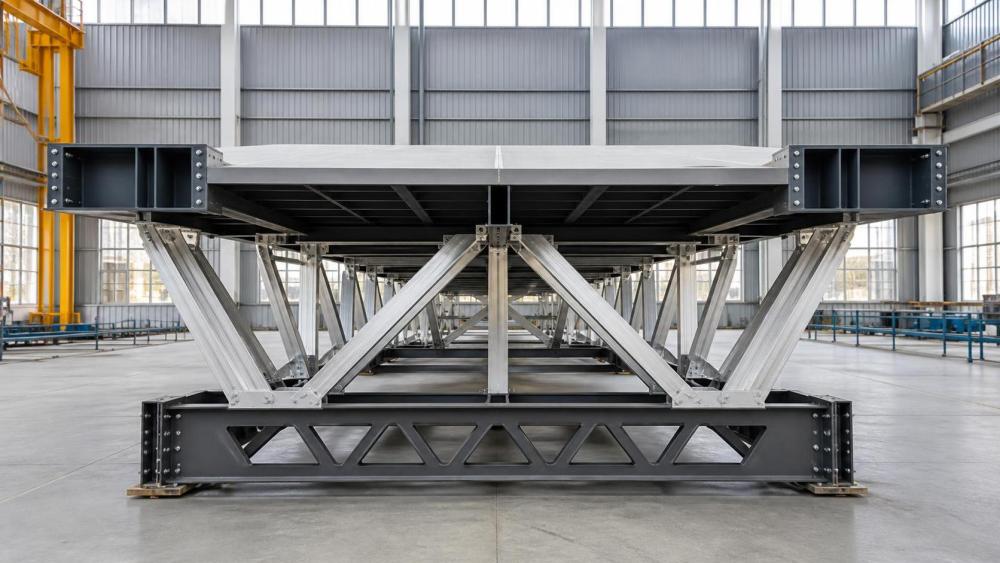
The most common result is not complete replacement. It is a hybrid design: steel where stiffness, toughness, and cost control matter most; aluminum where mass must be reduced; stainless steel where corrosion exposure is severe; and composites where directional reinforcement or lightweight shells deliver a genuine advantage.
The first question is not “Which material is stronger?”
Strength values alone can mislead material selection. A structural part must satisfy several different limits: yielding, buckling, deflection, fatigue, fracture resistance, local bearing, joint capacity, thermal movement, and environmental degradation. A replacement material that performs well in one category may perform poorly in another.
Consider a long support member. Substituting aluminum for steel may reduce weight substantially, but the lower elastic modulus of aluminum can lead to greater deflection unless the section geometry is enlarged. The redesigned component may need deeper ribs, a larger profile, or a different load path. In a space-constrained machine enclosure or vehicle frame, that geometry change can remove the expected benefit.
Composite materials require an even more careful reading of the load case. Carbon-fiber-reinforced polymer can deliver excellent performance in the fiber direction, but its behavior across the fiber direction and through the laminate thickness is different. Fastener holes, impact zones, cut edges, joints, and repeated load reversals must be designed deliberately. Treating a composite laminate as if it were an isotropic steel plate is a common source of poor design decisions.
Start with the failure mode that drives the design
A practical selection process begins by identifying what is most likely to govern the component. This step prevents a project from chasing lightweight materials where weight is not the true constraint.
- Static load and buckling: Important for columns, frames, support brackets, and compression members. Strength may not matter if instability controls first.
- Deflection and vibration: Critical for long spans, precision equipment, rotating machinery supports, flooring, and moving assemblies.
- Fatigue: Often governs cranes, vehicle structures, rolling equipment, offshore components, and parts exposed to vibration or repeated loading.
- Corrosion and chemical exposure: May justify stainless steel, coated steel, aluminum, or composites depending on the medium, temperature, and crevice conditions.
- Impact and damage tolerance: Relevant to industrial guards, transport structures, mining equipment, and areas exposed to dropped objects or debris.
- Temperature: Includes fire exposure, hot-process service, thermal cycling, and low-temperature toughness requirements.
Once the governing failure mode is clear, compare candidate materials against that mode at the component level rather than by raw material properties. The comparison should include section shape, joint design, manufacturing route, protective system, and expected inspection method. A material that looks superior in a data sheet can become less attractive after the full assembly is evaluated.
When aluminum is a sound structural substitute
Aluminum is often the most visible alternative to steel because its lower density offers immediate value in moving equipment. It is widely considered for vehicle frames, rail components, access platforms, marine structures, equipment housings, battery enclosures, and lightweight modular assemblies. Its natural oxide layer can also reduce maintenance needs in suitable environments.
However, aluminum is not simply “lighter steel.” It expands more with temperature changes, has lower stiffness, and requires attention to fatigue detail design. Welded aluminum structures can experience strength reduction in the heat-affected zone, depending on alloy and temper. Connections between aluminum and carbon steel need isolation where moisture and electrolyte exposure could create galvanic corrosion.
Aluminum performs best when the design can exploit its properties from the beginning. Extrusions, integrated ribs, closed sections, and carefully planned joints can compensate for lower stiffness. Replacing an existing steel plate with an aluminum plate of similar dimensions rarely produces the best result.
Why composites are valuable but not universal replacements
Fiber-reinforced composites are attractive where very low mass, corrosion resistance, or custom directional stiffness is valuable. They can be effective in panels, covers, walkways, reinforcement wraps, nonmagnetic structures, specialized vehicle parts, and certain offshore or chemical-service components. Their ability to form complex shapes can also reduce the number of separate parts in an assembly.
The trade-off is that composites demand more discipline in design and quality control. Internal delamination, moisture ingress, impact damage, resin degradation, and poor bond preparation may not be obvious from a visual inspection. Joining is particularly important: adhesive bonds require controlled surfaces and process consistency, while mechanical fasteners can introduce local stress concentrations. Fire response, smoke requirements, and long-term exposure to ultraviolet radiation or chemicals must also be checked for the specific resin system.
For these reasons, composites are frequently used where their advantages are decisive, not where steel is merely seen as outdated. A steel primary frame with composite panels or composite reinforcement may deliver a more reliable balance than a fully composite structure.
High-strength steel is often the overlooked “advanced material”
Material innovation does not always mean moving away from steel. Advanced high-strength steels, weathering steels, abrasion-resistant grades, duplex stainless steels, electrical steels, and specialized alloy steels expand what steel-based structures can do. In many applications, upgrading the steel grade or redesigning the section provides a better result than switching to aluminum or composites.
Higher-strength steel can permit thinner sections, lower mass, or increased load capacity. Yet the design team must confirm whether the component is strength-controlled. If deflection, buckling, or fatigue governs, simply selecting a stronger grade may have little effect. Fabrication must also be reviewed. Higher-strength grades can be more sensitive to bend radius, weld heat input, edge quality, and hydrogen control. A material upgrade that is not matched by suitable process control can create avoidable manufacturing risk.
Lifecycle cost is where many replacement decisions change
Initial material price is only one part of the decision. A lighter structure may lower operating energy use. A corrosion-resistant material may avoid coating renewal and shutdown time. A material that cannot be repaired easily, however, may create expensive downtime after localized damage. Procurement lead time, scrap recovery, joining consumables, inspection tools, workforce skills, and transport constraints also affect the real cost.
Mixed-material structures deserve particular attention. Combining steel with aluminum or composites can produce excellent performance, but it adds interfaces that must be controlled. Designers need to address differential thermal expansion, electrical isolation, sealing, moisture paths, adhesive durability, and access for inspection. The assembly process should be tested conceptually before the material decision is finalized: Can the parts be positioned accurately? Can joints be reached? Can protective coatings be applied after assembly? Can a damaged section be replaced without dismantling the whole structure?
A practical decision path for structural material substitution
- Define the component’s job. Record loads, load cycles, permitted deflection, service temperature, exposure conditions, required service life, and consequences of failure.
- Identify the dominant constraint. It may be mass, corrosion, fatigue, stiffness, thermal performance, manufacturability, or maintenance access.
- Compare complete designs. Evaluate redesigned sections and joints, not equal-thickness samples of different materials.
- Review the manufacturing route early. Include forming, rolling, casting, machining, welding, bonding, heat treatment, surface preparation, and inspection.
- Examine service and repair conditions. Ask how damage will be found, what repairs are feasible, and whether spare parts can be supplied consistently.
- Assess end-of-life handling. Steel and aluminum are well established in recycling systems; composites may require a more specialized recovery route.
This process provides a more useful answer than asking whether advanced materials are replacing traditional steel in structural applications in general. They are replacing it where the component-level gain outweighs the design, fabrication, and lifecycle trade-offs. Steel remains highly competitive where robustness, stiffness, familiar joining, and economical repair are central requirements.
Questions that often arise during material selection
Can carbon fiber replace steel in a load-bearing frame?
It can in specialized designs, but not as a direct one-for-one substitution. The frame must be designed around laminate direction, joint loads, impact exposure, inspection needs, and fire performance. Carbon fiber is most compelling when mass reduction has substantial operational value.
Is aluminum always better for lightweight structures?
No. Aluminum reduces mass, but lower stiffness may require a larger section. It is most effective when the geometry can be redesigned through extrusions, ribs, or closed profiles rather than copying the steel component shape.
Will advanced high-strength steel reduce structural weight?
Often, but only when yield strength is the governing limit. It may not reduce weight significantly where deflection, vibration, buckling, or connection design controls the component. Fabrication limitations should be reviewed alongside the structural calculation.
Which material is easiest to maintain in corrosive environments?
The answer depends on the specific environment. Coated carbon steel, stainless steel, aluminum, and composites each have different vulnerabilities. Salt exposure, trapped moisture, chemical concentration, temperature, abrasion, and joint design can change the preferred option.
Related News
- Mineral Sorting in Southeast Asia: Methods for Nickel and Tin OresOct 31, 2026Explore mineral sorting in Southeast Asia: compare nickel laterite screening and tin gravity separation, and discover how testing guides better flowsheet decisions.
- Metal Market Trends: Price and Supply Signals for Steel and Copper BuyersOct 19, 2026Explore metal market trends to decode steel and copper price shifts, supply risks, and delivery signals. Discover practical buying strategies to control costs and secure reliable supply.
- Mineral Sorting in the Middle East: Where Mining Projects Are Driving DemandOct 01, 2026Mineral sorting Middle East demand is accelerating as Saudi Arabia, Oman, and the UAE advance smarter, lower-impact mining projects. Explore the technologies and opportunities shaping the market.
- Decarbonization in Metallurgy: Practical Pathways for Lower-Emission SteelmakingSep 22, 2026Decarbonization in metallurgy: explore practical pathways for lower-emission steelmaking, from EAF and DRI to power strategy, traceability, and smarter capital planning.