
Related News
- 00
0000-00
Metal Transformation in Strip Processing: From Slab Reheating to Gauge Control - 00
0000-00
High-Recovery Mineral Dressing: Process Choices for Fine and Complex Ores - 00
0000-00
How to Vet a Construction Supply Solutions Supplier for Delivery, Quality, and Lead-Time Risk - 00
0000-00
How Refining Plant Systems Improve Metal Purity and Control Operating Costs - 00
0000-00
Electric Arc Furnace Systems in Latin America: How to Assess Grid, Scrap, and EAF Capacity
In harsh plants where abrasion, heat, corrosion, and heavy loads constantly attack equipment, selecting advanced materials is no longer optional for operators focused on uptime and safety. From mineral processing lines to rolling mills and smelting systems, the right wear-resistant solutions can reduce failures, extend service life, and improve production stability. This article explores practical material choices that help frontline teams perform better in demanding industrial environments.
What do operators really mean by advanced materials for wear resistance?
In heavy industrial plants, the term advanced materials usually refers to engineered metals, ceramics, composites, coatings, and surface-treated alloys designed to survive conditions that standard carbon steel cannot handle for long. Operators do not need abstract theory first; they need to know which materials reduce liner change frequency, protect shafts and rollers, resist slurry erosion, and keep hot-zone equipment stable under repeated thermal stress.
Wear is rarely caused by only one factor. In mineral machinery, hard particles cut and gouge chutes, screens, and pump parts. In smelting and refining, elevated temperature combines with oxidation and chemical attack. In continuous casting and rolling, contact pressure, friction, scale, and cyclic loading damage rolls, guides, and transfer components. In cooling and dedusting systems, wet corrosive dust and erosive flow can thin ducts, elbows, and fan elements faster than expected.
That is why advanced materials matter: they are selected not just for hardness, but for a balanced set of properties such as toughness, thermal stability, corrosion resistance, impact strength, fatigue life, and repairability. A very hard material may fail quickly if impact loads are high. A corrosion-resistant alloy may still underperform if abrasive fines dominate. Good selection starts with understanding the wear mechanism, not chasing one impressive property number.
Which advanced materials work best in different harsh plant conditions?
There is no universal winner. Different harsh plants demand different wear-resistant solutions, and the best advanced materials are the ones matched to the actual duty cycle. For frontline teams, the most useful way to compare options is by operating condition.
For high-abrasion zones such as ore chutes, hoppers, cyclone parts, and slurry pump liners, high-chromium white iron, wear plate with hardfacing, and ceramic-lined systems are often effective. These materials handle particle cutting and sliding wear well, especially where the flow is continuous and impact is moderate.
For impact-heavy areas like crusher liners, transfer points, and shovel-contact surfaces, quenched and tempered wear plate, manganese steel, and some rubber-composite systems may outperform brittle but harder options. In these areas, toughness protects against cracking and sudden edge failure.
For hot sections in furnaces, smelting lines, and radiant areas, heat-resistant stainless alloys, nickel-based alloys, and refractory-backed composite systems are common. These advanced materials are chosen because they maintain mechanical integrity at temperature while reducing oxidation, scale formation, and thermal deformation.
For rolling and precision contact applications, surface-engineered tool steels, carbides, and thermal spray coatings are often preferred. They can provide low wear, dimensional stability, and consistent surface interaction, which is especially valuable where strip quality and thickness control affect downstream value.
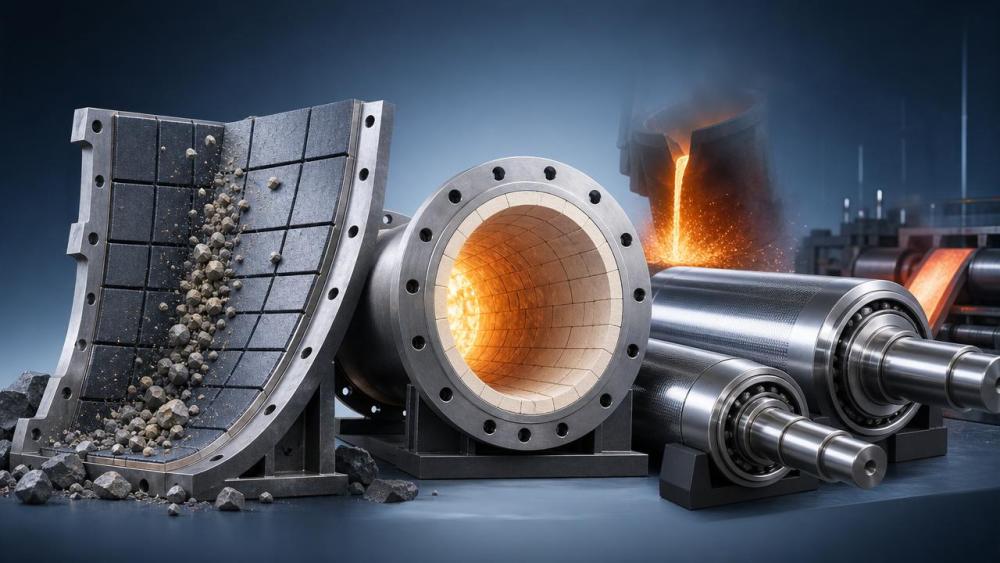
For wet corrosive environments such as scrubbers, cooling circuits, and dust-handling systems, duplex stainless steel, rubber-lined steel, polymer composites, or ceramic-polymer hybrids may deliver longer life than standard metal-only solutions. The reason is simple: once corrosion weakens the substrate, abrasion accelerates rapidly.
How should operators compare common advanced materials before maintenance or procurement decisions?
A practical comparison should include wear mode, operating temperature, impact level, corrosion exposure, shutdown cost, and ease of replacement. Looking only at purchase price is one of the most expensive mistakes in heavy industry, because downtime often costs more than the part itself.
This kind of comparison helps operators ask better questions. For example, if a chute fails every six weeks, is the problem bulk impact at loading, or fine sliding abrasion through the full path? If a roll surface degrades, is the root cause contact fatigue, temperature cycling, or scale-related scoring? Correct diagnosis leads to better use of advanced materials and avoids repeating the same maintenance cycle with a different brand name only.
What should operators check on site before choosing advanced materials?
Before selecting advanced materials, operators should document how, where, and how fast components fail. Useful evidence includes wear pattern photos, thickness loss data, operating temperatures, pH or chemical exposure, particle size distribution, material flow direction, impact points, and average service hours. Even simple records taken consistently can improve material selection more than a generic catalog recommendation.
It also helps to separate symptoms from causes. A liner that wears unevenly may indicate poor flow design, misalignment, or vibration rather than insufficient hardness alone. A coated shaft that peels could point to improper surface preparation, overload, or thermal mismatch between coating and substrate. When advanced materials are installed without solving design or process issues, performance gains stay limited.
For industries covered by MV-Core, this site-based thinking is especially important. Mineral sorting lines face changing ore characteristics. Smelting plants deal with heat flux, molten splash, and corrosive atmospheres. Rolling mills require dimensional precision, stable surface quality, and long campaign life. Cooling and dedusting equipment often sees a mix of moisture, dust, and chemical attack. Each environment changes what “best material” means.
A good rule is to check four basics before buying: failure mode, surrounding process conditions, maintenance window, and total replacement impact. If a part can only be changed during a major outage, higher-grade advanced materials may be justified even when the initial quote looks expensive. If replacement is fast and low-risk, a simpler material with predictable wear may be more economical.
What are the most common mistakes when using advanced materials in harsh plants?
The first common mistake is assuming harder always means better. In real plants, extreme hardness without toughness can create brittle failure, edge chipping, or catastrophic cracking. This is especially true where large rocks, thermal shock, or irregular loading are present.
The second mistake is treating all wear as abrasion. Many failures are mixed-mode: abrasion plus corrosion, heat plus scaling, or impact plus fatigue. Advanced materials should be selected for combined service conditions, not single-property marketing claims.
The third mistake is ignoring installation quality. Ceramic tiles, hardfacing overlays, sprayed coatings, and bonded liners can all underperform if the base surface, welding sequence, adhesive curing, or fastening method is wrong. Material quality alone cannot compensate for poor application control.
The fourth mistake is evaluating cost per part instead of cost per operating hour. A low-cost liner that requires repeated stoppages may be far more expensive over a year than a premium solution with double or triple service life. In continuous production systems, lost throughput, labor, and safety exposure must be included in the decision.
The fifth mistake is not planning for inspection. Even the best advanced materials need wear monitoring, because replacement timing affects both safety and asset protection. Running a wear part too far can damage neighboring structures, housings, or rotating equipment, turning a manageable consumable issue into a major repair.
How can advanced materials improve uptime, safety, and resource efficiency at the same time?
When matched correctly, advanced materials do more than resist wear. They stabilize operations. Longer service intervals reduce emergency maintenance, exposure to hazardous intervention, and unplanned production losses. In high-temperature or dust-intensive areas, better material performance can also lower leakage, decrease contamination, and support cleaner plant operation.
This matters across the broader industrial chain. In mineral machinery, durable liners and wear parts help maintain throughput consistency. In smelting and refining, heat-resistant components protect process reliability and energy performance. In continuous casting and rolling, stable surface materials support dimensional control and product quality. In cooling and dedusting systems, corrosion- and erosion-resistant parts help sustain environmental compliance and lower secondary maintenance burdens.
For operators, the practical value is clear: fewer shutdowns, more predictable inspections, safer work planning, and improved asset life. For plant managers, advanced materials support a larger goal—better resource efficiency. Using parts longer, replacing them less often, and preventing collateral damage all contribute to lower material waste and stronger lifecycle economics.
Which questions should be asked before requesting a quote or technical recommendation?
If you want a useful recommendation instead of a generic sales response, prepare a short but complete technical brief. Ask or provide the following information first:
- What exact component is failing, and what is the current material?
- Is the dominant problem abrasion, impact, heat, corrosion, or a combination?
- What is the average service life now, and what target life is realistic?
- What temperatures, particle sizes, moisture levels, or chemicals are present?
- Are there dimensional, weight, welding, or installation constraints?
- How costly is downtime, and how often can the component be changed?
- Is rebuild, relining, or coating preferable to full replacement?
These questions help suppliers, engineers, and maintenance teams narrow the field quickly. They also improve communication between operations and procurement, which is often where advanced materials projects succeed or fail. A technically credible decision usually comes from combining wear data, process reality, and replacement economics—not from selecting the hardest or most expensive option by default.
Final takeaway: how should operators move from interest to implementation?
The best use of advanced materials begins with a simple mindset: identify the actual wear mechanism, match material properties to the plant environment, and judge success by lifecycle performance rather than unit price. In harsh plants, this approach can deliver measurable improvements in uptime, safety, and product stability.
If you need to confirm a practical path forward, start by discussing component location, failure history, operating conditions, expected campaign life, maintenance access, and whether coating, composite lining, alloy upgrade, or full redesign makes the most sense. For teams working across mineral processing, smelting, rolling, and industrial environmental systems, those early questions create a stronger basis for technical evaluation, procurement timing, and long-term performance improvement.
Related News
- Are Advanced Materials Replacing Traditional Steel in Structural Applications?Sep 12, 2026Are there new advanced materials replacing traditional steel in structural applications? Explore when aluminum, composites, and high-strength steels deliver smarter performance.
- Which High-Quality Alloys Are Most in Demand for Hydrogen Energy Applications?Sep 11, 2026Which high-quality alloys are most in demand for hydrogen energy applications? Explore stainless steel, nickel alloys, titanium, and more for reliable hydrogen systems.
- Can Heavy Metal Industries Reach Net-Zero Emissions by 2035?Sep 09, 2026Do heavy metal industries have viable pathways to net-zero emissions by 2035? Explore practical strategies for electrification, recycling, and carbon capture.
- Zero-Emission Metallurgy for Foundries: Practical Routes to Cut CO2 and Energy UseJul 23, 2026Zero emission metallurgy for foundries made practical: explore proven ways to cut CO2 and energy use through electrification, heat recovery, cleaner charge materials, and digital control.