
Related News
- 00
0000-00
Metal Transformation in Strip Processing: From Slab Reheating to Gauge Control - 00
0000-00
High-Recovery Mineral Dressing: Process Choices for Fine and Complex Ores - 00
0000-00
How to Vet a Construction Supply Solutions Supplier for Delivery, Quality, and Lead-Time Risk - 00
0000-00
How Refining Plant Systems Improve Metal Purity and Control Operating Costs - 00
0000-00
Electric Arc Furnace Systems in Latin America: How to Assess Grid, Scrap, and EAF Capacity
Advanced materials are rapidly redefining how industrial equipment is engineered, specified, and marketed across global manufacturing. For distributors, agents, and channel partners, understanding these shifts is essential to identifying high-value opportunities in mineral processing, smelting, rolling, and environmental systems. This article explores the key material trends shaping performance, efficiency, durability, and competitive positioning in today’s heavy industry landscape.
For channel partners, a checklist-based approach is the fastest way to turn the broad topic of advanced materials into practical sales, sourcing, and market-development decisions. The reason is simple: equipment buyers in heavy industry do not purchase “innovation” in the abstract. They compare uptime, wear life, heat resistance, corrosion control, energy consumption, emissions compliance, and total lifecycle cost. If distributors can evaluate advanced materials through these decision points, they can position products more credibly, reduce project risk, and communicate value in commercial language that plant owners understand.
Start Here: Why Advanced Materials Matter Before You Compare Equipment
In mineral machinery, smelting systems, continuous casting lines, foil rolling mills, and industrial cooling or dedusting units, materials now influence far more than component longevity. They shape energy efficiency, digital controllability, maintenance intervals, safety margins, and decarbonization performance. This is especially relevant for MV-Core’s industrial focus, where equipment operates under abrasion, thermal shock, chemical attack, extreme loads, and strict production tolerances.
Before presenting any machine, spare part, or plant subsystem, distributors should first confirm whether the material upgrade changes one or more of the following commercial outcomes: lower failure frequency, improved process stability, reduced utility cost, higher throughput, cleaner emissions performance, or better compatibility with premium alloys and high-precision metal products. If none of these outcomes improve, the advanced materials claim may be technically interesting but commercially weak.
Core Evaluation Checklist: What to Check First When Advanced Materials Are Involved
Use the checklist below when screening suppliers, reviewing specifications, or advising buyers. These points help translate advanced materials trends into practical equipment decisions.
- Confirm the operating stress profile. Identify whether the component faces abrasion, impact, high temperature, molten metal exposure, corrosive gas, moisture, pressure cycling, or precision surface contact. Different advanced materials solve different stress combinations.
- Check the performance mechanism, not just the material name. A ceramic-lined chute, nickel-based alloy burner part, composite roll coating, or high-strength stainless duct should be assessed by what it improves in practice: wear life, oxidation resistance, thermal fatigue control, or reduced contamination.
- Ask for lifecycle data. Buyers increasingly prefer evidence such as operating hours, replacement intervals, energy savings, scrap reduction, or maintenance shutdown comparisons rather than generic claims about durability.
- Verify compatibility with the process medium. In heavy industry, a strong material can still fail if it reacts poorly with ore slurry, acid mist, chlorine-bearing gas, molten slag, cooling water chemistry, or rolling lubricants.
- Review fabrication and repairability. Some advanced materials perform well but require specialized welding, machining, joining, balancing, or coating restoration. This affects aftermarket profitability and service responsiveness.
- Check supply stability and standardization. Exotic materials with limited sourcing can create long lead times, inconsistent quality, or weak spare-parts continuity, all of which matter to distributors serving industrial clients with fixed shutdown windows.
- Evaluate cost versus uptime value. Premium materials often justify higher upfront pricing when they prevent unplanned stops, improve product consistency, or extend campaign length in hot and dirty operating environments.
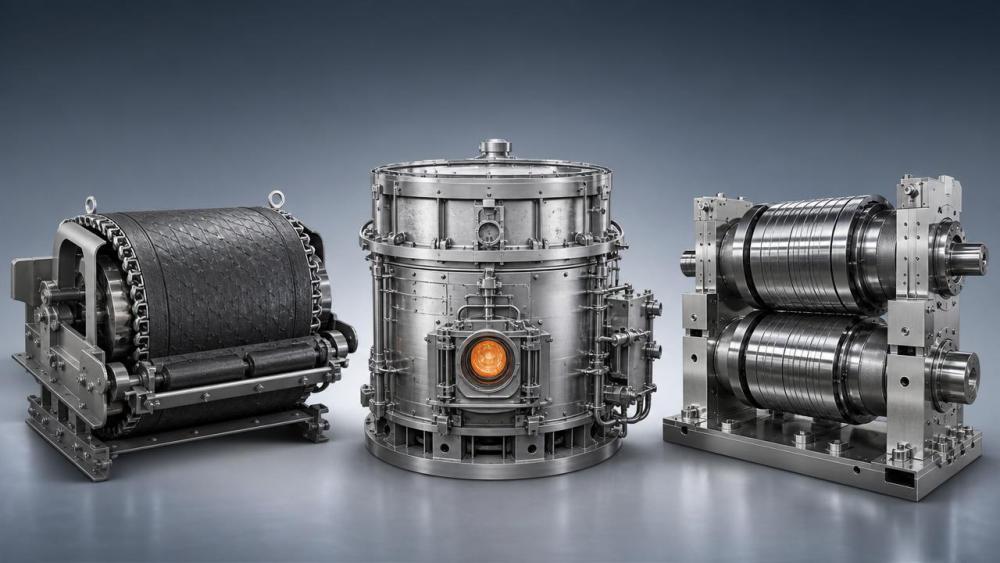
Priority Material Trends Reshaping Equipment Categories
1. Wear-Resistant Composites for Mineral Processing Equipment
In crushers, screens, feeders, separators, pumps, and slurry pipelines, advanced materials increasingly focus on wear-resistant composites, engineered ceramics, rubber-ceramic hybrids, and hardfacing solutions. The key decision standard is not maximum hardness alone. Distributors should check whether the material reduces liner change frequency, maintains flow geometry, and performs under both abrasion and impact. For mines and concentrators, this directly affects throughput stability and maintenance planning.
2. High-Temperature Alloys and Refractories for Smelting and Refining
In furnaces, launders, burners, ducts, and refining vessels, advanced materials trends are centered on thermal shock resistance, oxidation control, erosion resistance, and longer campaign life. Buyers want fewer emergency stoppages and better energy efficiency. Distributors should prioritize data on heat cycling, corrosion by slag or fumes, and compatibility with decarbonization upgrades such as electric heating, oxygen enrichment, or waste-heat recovery integration.
3. Precision Surface Materials for Casting and Rolling
Continuous casting and rolling equipment is being reshaped by advanced materials that improve dimensional control, surface finish, and thermal stability. This includes upgraded roll shells, coated guide elements, copper alloy components, bearing materials, and engineered lubricating surfaces. In foil and strip applications, even small material improvements can affect flatness, edge stability, thickness consistency, and defect rates. For channel partners, the question to ask is whether the material supports higher-value end products such as EV battery foil, electrical strip, or premium packaging stock.
4. Corrosion-Resistant Systems for Cooling and Dedusting
Environmental systems are no longer secondary. Advanced materials in ducts, filters, housings, fan components, heat exchangers, and water-treatment modules now influence emissions compliance and operating reliability. Corrosion-resistant steels, polymer composites, coated metals, and specialty filter media are increasingly important where acidic condensate, fine particulate, and variable temperatures coexist. Distributors should evaluate not only resistance to corrosion, but also cleanability, sealing integrity, and performance drift over time.
Quick Comparison Guide: Which Material Trend Fits Which Sales Opportunity?
Scenario-Based Checks for Distributors, Agents, and Regional Partners
Not every market responds to advanced materials in the same way. Distributors should adapt their checklist to the buyer profile and regional industrial maturity.
If the buyer is cost-sensitive
Lead with replacement frequency, labor savings, and shutdown avoidance rather than scientific material details. In many cases, a moderate upgrade in advanced materials with shorter payback is easier to sell than a top-tier specification with a long return period.
If the buyer targets premium metal products
Focus on contamination control, surface quality, temperature uniformity, and thickness precision. Here, advanced materials support value capture through better final product quality rather than only longer component life.
If the project includes green or low-emission goals
Prioritize materials that contribute to heat retention, reduced leakage, improved filtration efficiency, corrosion resistance in wet-gas conditions, and compatibility with electrified or digitally optimized systems. This is particularly relevant for strategic sectors linked to green steel, battery metals, and resource-efficiency upgrades.
Commonly Overlooked Risks When Selling Advanced Materials Solutions
- Assuming premium material always means premium value. A mismatch between operating conditions and material function can erase benefits quickly.
- Ignoring joining and installation quality. Advanced materials can fail early when mounting, welding, bolting, or thermal expansion allowances are poorly managed.
- Selling based on laboratory metrics only. Heavy industry buyers care more about plant data than isolated hardness, strength, or temperature numbers.
- Underestimating spare-parts strategy. If the supply chain for advanced materials is narrow, customers may reject the offer despite technical advantages.
- Missing the downstream quality link. In rolling and foil applications, material upgrades may change surface interaction, affecting yield, tolerances, or customer acceptance.
Execution Plan: What to Prepare Before Recommending an Advanced Materials Upgrade
To move from trend awareness to deal execution, distributors should prepare a compact technical-commercial package. This improves credibility and shortens the decision cycle.
- A clear description of the current failure mode or performance bottleneck.
- Operating parameters such as temperature range, media composition, pressure, wear source, duty cycle, and maintenance interval.
- A before-and-after value estimate covering lifecycle cost, downtime exposure, energy impact, and product quality effect.
- Supplier evidence, including case studies, material certificates, reference installations, and repair or replacement procedures.
- A spare-parts and service plan aligned with the customer’s shutdown schedule and regional support expectations.
For organizations tracking industrial intelligence through MV-Core, this preparation is most effective when combined with sector insight. Market trends in mineral sorting, electric arc furnace energy management, sub-micron rolling control, and heavy industrial environmental systems all influence which advanced materials will gain adoption first. In other words, material selection should not be isolated from broader plant modernization, decarbonization priorities, and evolving raw-material strategies.
FAQ: Fast Answers for Channel Partners
How can distributors explain advanced materials without sounding overly technical?
Translate the material upgrade into plant outcomes: longer service life, fewer shutdowns, lower energy use, cleaner production, or better metal quality. Buyers respond to measurable impact.
Which industrial segments are adopting advanced materials fastest?
High-wear mineral processing, high-temperature smelting, precision rolling for copper and aluminum foil, and corrosion-sensitive cooling and dedusting systems are among the fastest-moving segments.
What is the best proof point in a sales discussion?
Comparable field performance data is usually strongest, especially when it connects advanced materials to uptime, maintenance cost, throughput, or defect reduction.
Final Action Guide: Questions to Raise Before the Next Customer Conversation
As advanced materials continue reshaping industrial equipment design, distributors and agents should avoid treating the topic as a general trend alone. The real opportunity lies in asking sharper questions. Which component fails first? What operating condition is most destructive? Is the buyer trying to cut emissions, extend campaign life, increase precision, or reduce contamination risk? How stable is the supply chain for the upgraded material? What proof exists under similar process conditions?
If you need to move a project forward, prioritize discussion around operating parameters, target service life, compatibility, maintenance constraints, delivery cycle, budget range, and local support expectations. These points will reveal whether an advanced materials solution is commercially ready, technically suitable, and scalable for long-cycle industrial equipment sales. For channel partners serving heavy industry, that level of preparation is what turns material trends into durable market advantage.
Related News
- Are Advanced Materials Replacing Traditional Steel in Structural Applications?Sep 12, 2026Are there new advanced materials replacing traditional steel in structural applications? Explore when aluminum, composites, and high-strength steels deliver smarter performance.
- Which High-Quality Alloys Are Most in Demand for Hydrogen Energy Applications?Sep 11, 2026Which high-quality alloys are most in demand for hydrogen energy applications? Explore stainless steel, nickel alloys, titanium, and more for reliable hydrogen systems.
- Can Heavy Metal Industries Reach Net-Zero Emissions by 2035?Sep 09, 2026Do heavy metal industries have viable pathways to net-zero emissions by 2035? Explore practical strategies for electrification, recycling, and carbon capture.
- Zero-Emission Metallurgy for Foundries: Practical Routes to Cut CO2 and Energy UseJul 23, 2026Zero emission metallurgy for foundries made practical: explore proven ways to cut CO2 and energy use through electrification, heat recovery, cleaner charge materials, and digital control.