
Related News
- 00
0000-00
Metal Transformation in Strip Processing: From Slab Reheating to Gauge Control - 00
0000-00
High-Recovery Mineral Dressing: Process Choices for Fine and Complex Ores - 00
0000-00
How to Vet a Construction Supply Solutions Supplier for Delivery, Quality, and Lead-Time Risk - 00
0000-00
How Refining Plant Systems Improve Metal Purity and Control Operating Costs - 00
0000-00
Electric Arc Furnace Systems in Latin America: How to Assess Grid, Scrap, and EAF Capacity
For business decision-makers, aluminum foil equipment is not just a capital investment—it directly shapes throughput, yield stability, and scrap control. From rolling precision to process automation, the right equipment choices can reduce material loss, improve consistency, and strengthen long-term competitiveness. This article explores how key equipment decisions influence output efficiency and scrap rates across modern foil production.
In foil operations serving EV battery materials, high-end packaging, and industrial laminates, a difference of a few microns can decide whether a coil is sold at premium value or downgraded. That is why aluminum foil equipment selection should be evaluated not only by purchase price, but by its effect on thickness tolerance, line speed, downtime, energy stability, and operator dependency over 3 to 10 years of plant operation.
For leaders responsible for capital planning, capacity expansion, or process upgrades, the key question is simple: which equipment decisions create more saleable tons per month while keeping scrap, rework, and process risk within acceptable limits? The answer lies in understanding the interaction between rolling stands, automation systems, slitting quality, tension control, lubrication, and downstream inspection.
Why Equipment Choice Has a Direct Impact on Foil Output
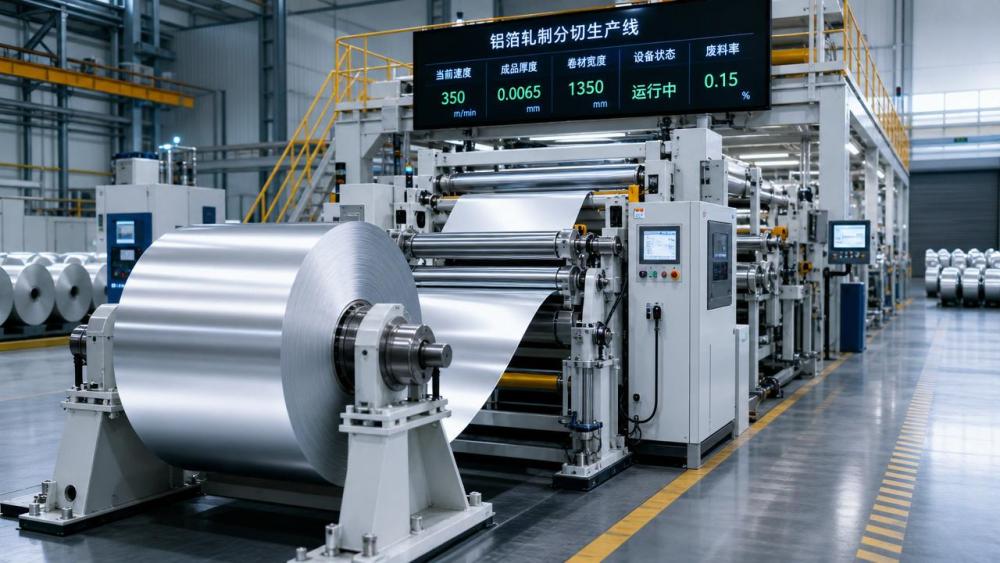
Output in a foil plant is not determined by nominal line speed alone. A mill rated for 600 m/min may deliver far less if gauge fluctuation forces speed reduction, if frequent strip breaks interrupt production, or if changeover time extends beyond 45 to 90 minutes per coil family. In practice, effective output depends on stable operation across the entire process window.
When buyers compare aluminum foil equipment, they should focus on three production realities. First, precision defines how close the process can run to target thickness without oversafe rolling. Second, automation determines whether performance is repeatable across shifts. Third, equipment rigidity and control response influence how quickly the line recovers after speed changes, roll wear, or material variation.
The hidden cost of conservative rolling
Plants with older or lower-stability mills often compensate by rolling slightly thicker than target to avoid off-spec product. A 2% to 4% thickness buffer may look small, but over thousands of tons annually it can materially reduce margin. Better aluminum foil equipment allows operators to run closer to specification, turning metal that would have become process giveaway into sellable output.
How uptime and speed stability shape annual tonnage
If two lines have the same theoretical capacity, but one loses 6% of scheduled time to strip breaks, tension instability, and manual intervention, the production gap over 12 months becomes significant. Even a 3% to 5% improvement in line availability can be more valuable than a headline speed increase that cannot be sustained under real material conditions.
Key output variables to review during procurement
- Stable thickness control range, often measured in microns rather than only percentage deviation
- Maximum and sustainable rolling speed under target alloy and temper conditions
- Average coil changeover time, commonly 20 to 60 minutes depending on line design
- Frequency of unplanned stoppages per shift or per 100 operating hours
- Automation support for recipe storage, fault diagnosis, and repeatable setup
The table below shows how common equipment decisions influence output, labor dependency, and process consistency in foil manufacturing environments.
For procurement teams, the lesson is practical: output gains rarely come from one machine parameter alone. The best aluminum foil equipment packages create a stable system where speed, gauge, tension, and maintenance all support continuous production rather than forcing operators into defensive settings.
How Equipment Configuration Changes Scrap Rates
Scrap in foil production is usually created through a combination of edge cracking, thickness inconsistency, surface defects, telescoping, strip breaks, and startup losses. While alloy quality and operator discipline matter, equipment configuration strongly influences how often these issues occur and how much metal is lost each time. In many plants, scrap reduction of 1% to 3% can justify a significant upgrade decision.
Rolling precision and flatness control
Foil is sensitive to small mechanical deviations. Mill stiffness, roll crown management, bending control, and thermal balance all affect flatness and gauge profile. If a line cannot hold tight control across strip width, edge zones may fall outside tolerance, creating trim loss or downgraded product. For thin-gauge applications, even small profile errors can trigger repeated corrections and extra scrap during startup.
Surface quality systems and contamination control
Surface defects are a major commercial risk in battery foil and premium packaging. Aluminum foil equipment with poorly managed lubrication, weak filtration, or unstable coolant temperature can introduce rolling marks, oil stains, or embedded particles. Temperature stability within a narrow operational band, often around 2°C to 5°C variation, helps maintain process consistency and reduce defect-driven rejection.
Slitting, rewinding, and edge integrity
Scrap does not end at the rolling mill. Improper slitter alignment, worn knives, or uneven rewind tension can convert acceptable rolled stock into edge-damaged finished coils. Decision-makers should treat finishing equipment as part of the same quality chain. A bottleneck or weak point after rolling can erase the value created upstream.
The following comparison outlines the most common sources of scrap and the equipment-related measures that typically reduce them.
This is why investment reviews should measure scrap by category rather than as one total number. If 40% of material loss comes from startup waste and another 25% from edge damage, the correct equipment response is different in each case. Targeted upgrades outperform broad assumptions.
Critical Selection Criteria for Decision-Makers
A sound procurement decision balances throughput, scrap control, future product mix, and lifecycle serviceability. In practice, buyers should evaluate at least 4 dimensions: technical fitness, operational stability, maintenance burden, and scalability. A lower initial quote can become expensive if the line requires more manual correction, spare parts lead times exceed 8 to 12 weeks, or future alloy programs demand retrofits.
1. Match equipment to target foil grades
Not all aluminum foil equipment is optimized for the same end markets. Household foil, pharmaceutical foil, capacitor foil, and battery current collector foil each demand different levels of surface cleanliness, thickness stability, and edge quality. Buyers should map the next 24 to 36 months of product strategy before freezing equipment specification.
2. Review automation depth, not just hardware strength
Mechanical quality remains essential, but digital control often determines repeatability. Recipe management, real-time alarms, pass schedule optimization, and data logging reduce operator variability across 2 or 3 shifts. For plants with mixed-experience teams, higher automation can lower the learning curve and stabilize scrap performance faster after commissioning.
3. Evaluate maintenance access and spare parts logic
A technically advanced line is less valuable if maintenance tasks require prolonged shutdowns. Decision-makers should ask how long it takes to replace critical wear parts, how often calibration is needed, and whether remote diagnostics are available. Preventive maintenance windows of 4 to 8 hours are easier to integrate than unplanned failures that stop a line for 2 or 3 days.
Procurement checklist
- Define target alloys, widths, gauges, and monthly tonnage by product family
- Quantify current scrap by defect type and by process step
- Set acceptable thresholds for downtime, gauge deviation, and changeover time
- Compare supplier capability in commissioning, training, and after-sales response
- Model payback using yield improvement, not only speed increase
This approach is especially relevant for businesses following the MV-Core view of resource efficiency. In heavy industry, smarter equipment decisions support not just productivity, but also lower energy waste, better metal utilization, and a stronger operating position in markets where quality claims must be backed by process discipline.
Implementation Priorities After Equipment Selection
Choosing the right aluminum foil equipment is only the first stage. Output and scrap performance depend on commissioning discipline, operator training, and data feedback during the first 90 to 180 days. Plants that treat startup as a structured optimization program generally reach stable capacity faster than plants that rely on ad hoc adjustment.
Commissioning in three practical phases
Phase 1 is mechanical validation: alignment, vibration, tension response, thermal checks, and safety verification. Phase 2 is process tuning: pass schedule confirmation, lubrication optimization, and thickness calibration across representative alloys. Phase 3 is production stabilization: standard recipes, shift training, scrap tracking, and KPI review by coil family.
KPIs worth tracking from week one
Leaders should track at least 6 early indicators: actual tons per shift, scrap percentage by cause, strip break frequency, average setup time, off-gauge length during startup, and planned versus unplanned downtime. These metrics expose whether the new line is creating structural gains or merely shifting losses to another stage.
Typical early-stage warning signs
- Speed drops of more than 10% when moving to thinner gauges
- Repeated manual tension correction on similar coil programs
- Scrap concentrated in first-coil startup rather than steady-state rolling
- Surface defect spikes after lubricant change or filter saturation
- Frequent operator override of automated settings
When these signs appear, the issue is often not one isolated defect but a mismatch between equipment capability, process recipes, and maintenance rhythm. The fastest improvements usually come from cross-functional review involving production, quality, maintenance, and supplier engineering support.
Common Buying Mistakes and How to Avoid Them
One common mistake is buying aluminum foil equipment based only on rated speed or headline thickness range. Without examining sustainable performance, companies may install lines that look competitive on paper but underperform in thin-gauge, high-cleanliness, or multi-shift operations. Another mistake is underestimating how much downstream finishing equipment affects overall scrap.
Mistake 1: Separating rolling and finishing decisions
If rolling quality improves but slitting and rewinding remain inconsistent, the plant still loses value. Decision-makers should review the line as an integrated system from entry coil to final packed roll.
Mistake 2: Ignoring operator dependency
A line that performs well only under the best technician is not a stable business asset. Repeatability across shifts is more important than isolated peak output. Strong automation and clear standard operating windows matter more than optimistic trial conditions.
Mistake 3: Failing to link capex with resource efficiency
In modern industrial strategy, scrap is not just a production issue; it is a raw material efficiency issue. Lower trim loss, fewer rejected coils, and reduced restart waste support both profitability and sustainability goals. For companies active in energy-transition supply chains, this link is increasingly strategic.
The strongest equipment decisions are those that convert metallurgical precision into business resilience. Better aluminum foil equipment can raise sellable output, reduce avoidable scrap, simplify process control, and support expansion into higher-spec applications. For enterprise decision-makers, the real benchmark is not the machine alone, but the long-term economics of stable quality, efficient metal use, and reliable delivery performance.
If your team is evaluating new foil rolling lines, process upgrades, or scrap-reduction priorities, MV-Core can help translate technical options into decision-ready intelligence. Contact us to discuss your target product mix, compare equipment pathways, and get a more practical view of how aluminum foil equipment choices affect output, yield, and competitive positioning.
Related News
- Industrial Solutions Performance Review: Which KPIs Matter Before Scaling a Plant?Sep 12, 2026Industrial solutions performance review: identify the KPIs for throughput, yield, energy, reliability, quality, and compliance before scaling your plant.
- Molten Metal Smelting in Latin America: Capacity, Energy Costs, and Investment RisksSep 08, 2026Molten smelting Latin America: assess usable capacity, delivered energy costs, logistics, and investment risks to identify resilient metal project opportunities.
- Mineral Sorting Cost: How Equipment, Capacity, and Operating Expenses Shape PricingSep 07, 2026Mineral sorting cost depends on equipment, capacity, feed preparation, and operating expenses. Explore practical cost factors to compare solutions and improve ROI.
- Are Advanced Materials Replacing Traditional Steel in Structural Applications?Sep 12, 2026Are there new advanced materials replacing traditional steel in structural applications? Explore when aluminum, composites, and high-strength steels deliver smarter performance.