
Related News
- 00
0000-00
Metal Transformation in Strip Processing: From Slab Reheating to Gauge Control - 00
0000-00
High-Recovery Mineral Dressing: Process Choices for Fine and Complex Ores - 00
0000-00
How to Vet a Construction Supply Solutions Supplier for Delivery, Quality, and Lead-Time Risk - 00
0000-00
How Refining Plant Systems Improve Metal Purity and Control Operating Costs - 00
0000-00
Electric Arc Furnace Systems in Latin America: How to Assess Grid, Scrap, and EAF Capacity
Buying aluminum foil equipment is a strategic decision that affects product quality, energy efficiency, maintenance costs, and long-term competitiveness. For procurement teams, the key is not just comparing prices, but evaluating rolling precision, production capacity, automation level, material compatibility, and supplier support. Before making an investment, it is essential to understand what truly determines reliable performance and sustainable value.
Why application scenarios matter before selecting aluminum foil equipment
For procurement professionals, the most common mistake is treating aluminum foil equipment as a standard industrial purchase. In reality, the right machine for battery foil is not automatically right for household foil, pharmaceutical packaging, or insulation applications. Each scenario has different expectations for gauge tolerance, pinhole control, surface quality, slitting accuracy, line speed, and cleanliness. A supplier may offer an attractive quotation, but if the equipment is not aligned with your downstream market, the real cost will appear later in rejects, downtime, customer complaints, and expensive retrofits.
This is why scenario-based evaluation should come before model comparison. Procurement teams should begin with business use, not machine brochures. Ask: What foil grades will be produced? How often will product specifications change? Is the project focused on volume, precision, or multi-product flexibility? Will the plant serve export markets that require tighter quality documentation? The answers define what to check before buying aluminum foil equipment far better than nameplate capacity alone.
Common business scenarios and what each one demands
Different industries use aluminum foil in very different ways. A high-speed packaging converter usually prioritizes stable output and low scrap, while an EV battery materials producer may focus on micron-level thickness consistency and digital process control. Understanding these differences helps procurement teams avoid overbuying or underbuying.
The table above shows why aluminum foil equipment should never be evaluated in isolation. The same mill type may perform well in one commercial scenario and poorly in another. Procurement decisions become stronger when each requirement is tied to a real production target and customer expectation.
Scenario 1: If you serve battery foil or high-end electronics, precision comes first
In advanced manufacturing segments such as NEV battery foil, tolerance is not just a quality issue; it is a market entry requirement. Buyers in this scenario should pay special attention to the foil rolling mill’s ability to maintain stable thickness over long runs, not only under ideal test conditions but during real production with coil changes, speed variation, and thermal drift.
Check whether the aluminum foil equipment includes automatic gauge control, flatness control, high-response hydraulic systems, and robust roll cooling management. Ask for defect data, not just brochure claims. How does the machine perform in pinhole reduction? What is the actual thickness deviation across coil width? Can the system provide digital records for process traceability? In premium segments, traceability and data integration increasingly matter as much as mechanical design.
Another key point is cleanliness. Battery foil and electronic foil require stricter control of rolling oil, airborne particles, and surface contamination. Procurement teams should assess supporting systems such as filtration, oil purification, exhaust treatment, and workshop environmental control. In many cases, aluminum foil equipment value is determined by the total process ecosystem rather than the main stand alone.
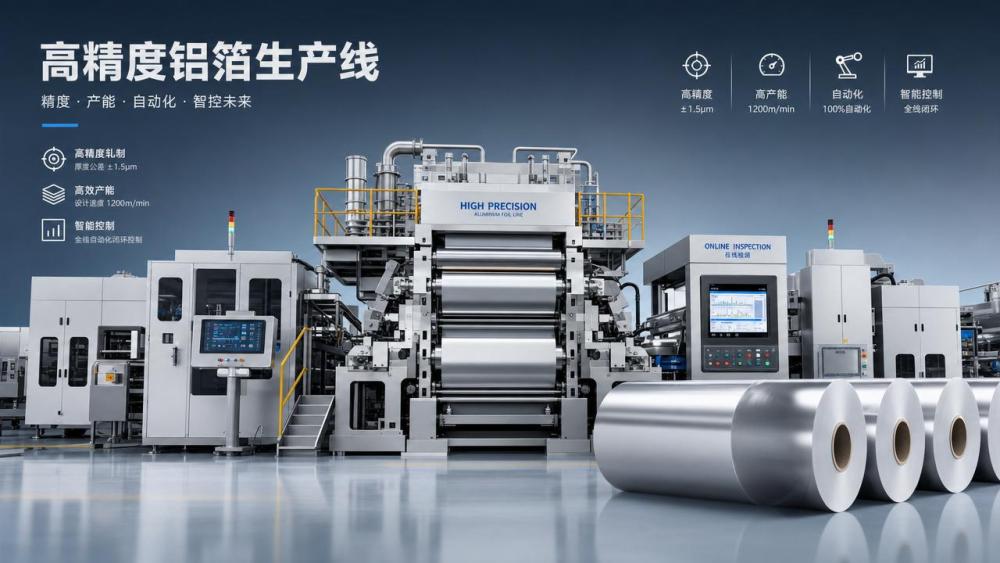
Scenario 2: If you produce packaging foil, balance speed with defect control
Packaging foil buyers usually work under pressure from both converters and brand owners. Output must be high, but consistency cannot drop. In this scenario, procurement should focus on how the aluminum foil equipment performs at commercial speed over a broad mix of widths and gauges. A machine that reaches a headline speed but suffers frequent breakage or unstable winding may reduce actual annual output.
Important checks include strip threading stability, tension control, work roll change efficiency, and slitting performance. Surface quality also deserves close review because downstream lamination, printing, and sealing processes are sensitive to scratches, oil residues, and uneven winding. Ask to see customer references in packaging foil specifically, because experience in thick-gauge rolling does not automatically translate into thin packaging foil competence.
If your product mix changes frequently, flexibility becomes a purchasing advantage. Aluminum foil equipment with faster setup, recipe storage, and easier operator interfaces can reduce transition losses and improve response to short lead times. For procurement teams, this often means looking beyond machine price to total operating efficiency.
Scenario 3: If your priority is household foil or container foil, economics and uptime dominate
Large-volume foil products compete heavily on cost. In this business model, the best aluminum foil equipment is not necessarily the most technically advanced machine, but the one that delivers reliable output with manageable maintenance and energy use. Procurement teams should compare annual capacity, utility consumption, spare parts availability, and operator training demands.
This is also the scenario where maintainability becomes a major purchasing criterion. Ask practical questions: How long does planned maintenance take? Are critical components sourced locally or imported with long lead times? Is the control system based on widely supported platforms? Can in-house technicians troubleshoot core issues, or does every interruption require an overseas service team?
For cost-sensitive applications, a slightly lower-capex option may become expensive if roll life is short, power demand is high, or scrap rates increase during peak production. Procurement should model total cost of ownership over several years rather than comparing quotations line by line.
Scenario 4: If you supply regulated sectors, supplier capability matters as much as the machine
Pharmaceutical packaging, food-contact materials, and export-oriented foil production often require stricter documentation and quality discipline. In these scenarios, procurement teams should evaluate the supplier behind the aluminum foil equipment just as carefully as the technical specification. A capable supplier should provide validation support, inspection logic, commissioning protocols, and long-term service commitments.
Check whether the supplier can support quality documentation, calibration records, acceptance testing, and operator qualification. Also review whether the equipment design supports contamination control, consistent winding, and stable defect inspection. In regulated applications, poor documentation can delay production qualification even if the machine itself is mechanically sound.
Core technical checkpoints every procurement team should verify
Regardless of scenario, several checkpoints should always be part of aluminum foil equipment evaluation. First, confirm the workable thickness range and the supplier’s proven results at your target gauge, not just the nominal machine design. Second, review alloy compatibility because foil performance can vary depending on raw material characteristics and downstream specifications. Third, examine automation architecture, including PLC, sensors, human-machine interface, alarm logic, and data collection capability.
Fourth, assess energy and environmental systems. Efficient cooling, rolling oil circulation, fume control, and dust collection affect both operating cost and compliance. This is especially important for companies pursuing greener manufacturing or planning long-term export competitiveness. Fifth, inspect safety systems, because high-speed foil rolling involves mechanical, hydraulic, and thermal risks that must be managed through well-designed interlocks and protection logic.
Finally, request evidence. Good aluminum foil equipment suppliers should be able to provide process data, reference installations, sample quality results, factory acceptance procedures, and service response commitments. Procurement decisions improve when claims are verified through site visits or live production reviews.
Common misjudgments when buying aluminum foil equipment
One common mistake is buying equipment with excessive sophistication for a simple product line. This can increase capex, complexity, and maintenance without producing commercial returns. Another mistake is the opposite: selecting lower-spec aluminum foil equipment for a future upgrade path that requires tighter tolerances. The result is early replacement pressure or costly modifications.
A third misjudgment is ignoring upstream and downstream compatibility. Foil rolling performance depends on casting quality, intermediate stock condition, annealing, slitting, and coil handling. If these linked processes are unstable, even excellent aluminum foil equipment may fail to deliver target quality. Procurement teams should therefore evaluate the line as part of a broader production chain.
Another overlooked area is after-sales support. Spare parts strategy, remote diagnostics, software updates, and training depth often determine how quickly the line reaches stable output. A low initial purchase price can be offset by service delays and long recovery times.
How to match equipment choice with company size and purchasing objective
A new market entrant may need aluminum foil equipment that prioritizes flexibility, manageable investment, and rapid operator learning. An established manufacturer may instead prioritize automation depth, integration with MES or ERP systems, and lower unit operating cost. A trading-oriented investor entering foil production may focus on risk control, supplier reliability, and future scalability. These are not small differences; they shape what “best value” actually means.
Procurement should define success in business terms before final negotiation. Is the project expected to secure high-end customers, reduce dependence on external converters, expand export capacity, or improve energy efficiency? Once the target is clear, the equipment checklist becomes more objective and less vulnerable to sales pressure.
FAQ for procurement teams evaluating aluminum foil equipment
Is higher speed always better?
No. For many applications, stable speed with low breakage and low defect rates creates better annual output than a faster line with frequent interruptions.
Should we prioritize imported or local equipment?
The better choice depends on your scenario. High-precision sectors may justify premium systems, while volume-driven projects may benefit from locally serviceable aluminum foil equipment with strong uptime support.
How important is automation?
Very important when product quality is tight, labor costs are rising, or traceability is required. For simpler products, the right level of automation should improve repeatability without creating unnecessary complexity.
Final decision guide: buy for your real scenario, not for the brochure
The best aluminum foil equipment is the one that fits your application, customer standards, production rhythm, and service reality. Procurement teams should compare not only machine parameters, but also scenario fit, quality consistency, energy performance, maintainability, and supplier credibility. In battery foil, precision and cleanliness lead. In packaging foil, productivity and defect control must be balanced. In household and container foil, uptime and operating cost are often decisive. In regulated sectors, documentation and support can be as critical as rolling performance.
Before signing any contract, build a scenario-based checklist, verify operating references, and map technical claims to business outcomes. That approach reduces procurement risk and increases the chance that your aluminum foil equipment investment will deliver durable value in a competitive industrial market.
Related News
- Industrial Solutions Performance Review: Which KPIs Matter Before Scaling a Plant?Sep 12, 2026Industrial solutions performance review: identify the KPIs for throughput, yield, energy, reliability, quality, and compliance before scaling your plant.
- Molten Metal Smelting in Latin America: Capacity, Energy Costs, and Investment RisksSep 08, 2026Molten smelting Latin America: assess usable capacity, delivered energy costs, logistics, and investment risks to identify resilient metal project opportunities.
- Mineral Sorting Cost: How Equipment, Capacity, and Operating Expenses Shape PricingSep 07, 2026Mineral sorting cost depends on equipment, capacity, feed preparation, and operating expenses. Explore practical cost factors to compare solutions and improve ROI.
- Are Advanced Materials Replacing Traditional Steel in Structural Applications?Sep 12, 2026Are there new advanced materials replacing traditional steel in structural applications? Explore when aluminum, composites, and high-strength steels deliver smarter performance.